
Katherine D. Harris (San Jose State University)
Thursday 19 March, 11 am – 12 noon
Puaka James Hight 210
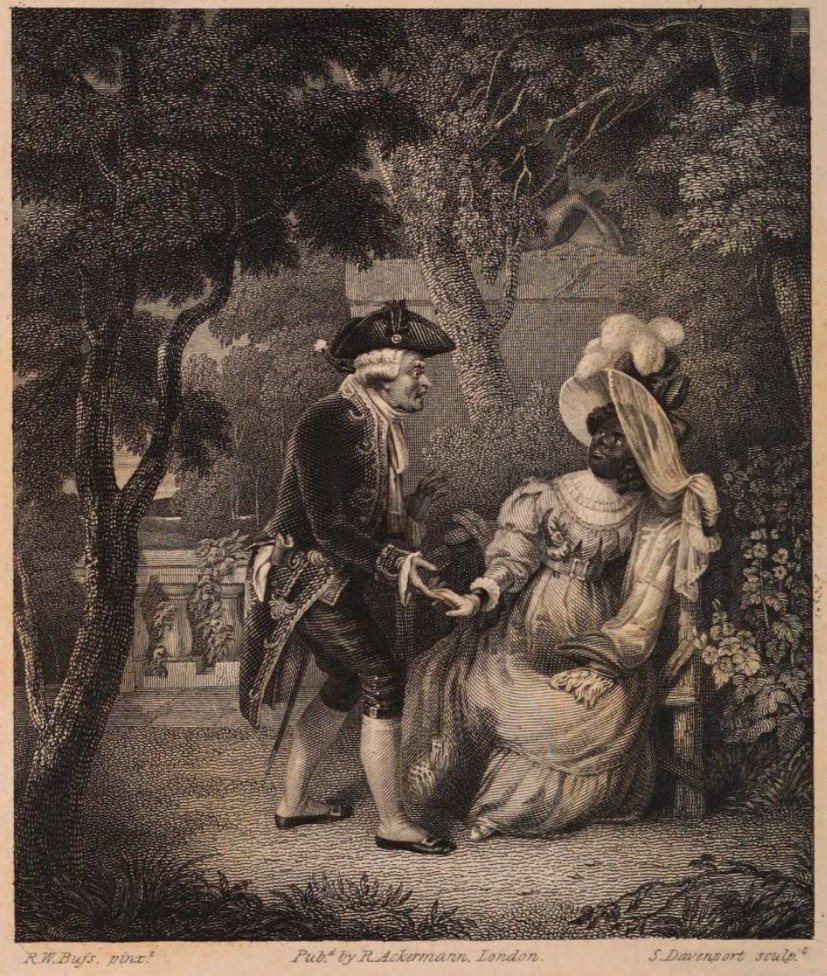
In the short story, “Uncle Anthony’s Blunder,” a gentleman approaches a young lady whose back is turned to him. From behind, she is dressed in fine clothing with hands covered by gloves. Before waiting for her to turn around, the older man, Antony Nesfield, blurts out a proposal of marriage, however, when she turns around, he discovers that she’s Jamaican and Black – a case of mistaken identity. The engraving and following short story appear on page 231 of a 343-page duodecimo volume, published in the 1833 Forget Me Not, a literary annual title that first appeared in 1823 and lead the revolution in combining the almanac, women’s conduct manuals, and emblem books. Each annual, usually with 40-50 literary texts ranging from essays to short stories, a presentation plate, and 10-12 engravings, were published in November intended as gifts for the New Year and beautifully bound in embossed leather or red silk with gilt-edged pages. Rudolph Ackermann, the publisher of The Repository of Arts, had a keen sense of popular taste with other publications such as The World in Miniature (1821-1827) that offered insight into the manners, customs, and characteristics of various nations. He was not unfamiliar with readers’ appetite for cultures far away from the British shores.
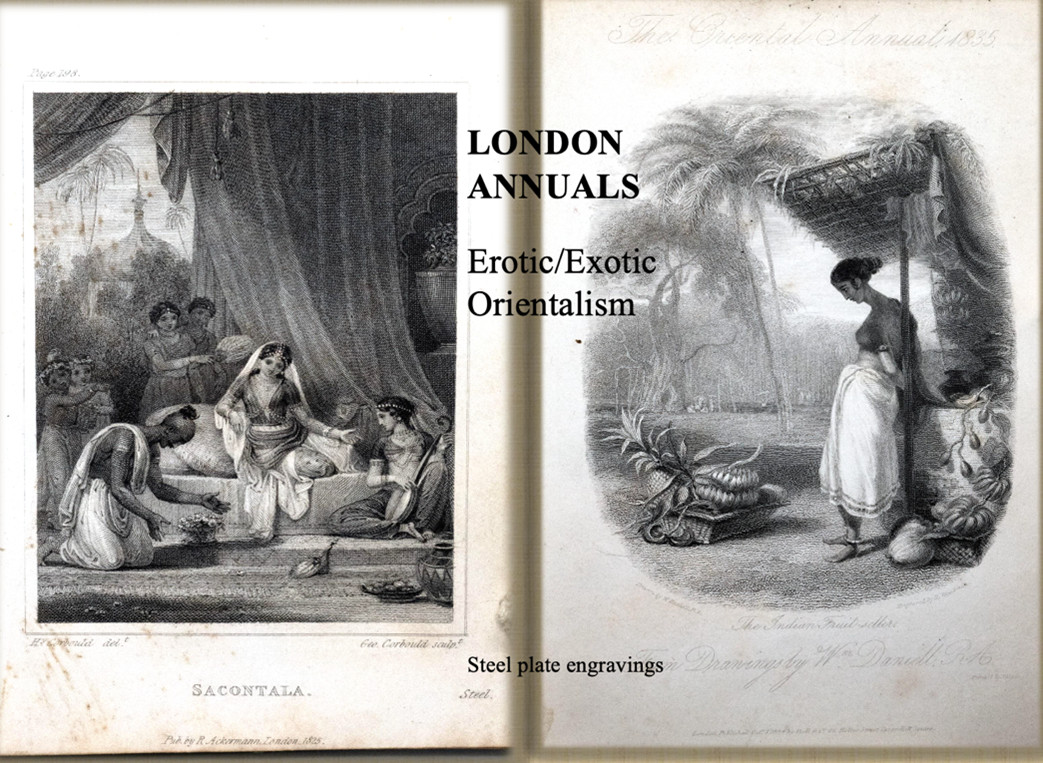
This vignette of a Jamaican woman with dark-textured facial skin centered as the focal point of the engraving and touching a white man is extremely unusual. The representation of women from around the world, and specifically British colonies is usually exoticized, eroticized, and subservient to others in the engraving.
“Uncle Anthony’s Blunder” likely exploits the visual humor of colonial encounter and misrecognition—an image that reflects both the expanding British empire’s social imagination and the racial anxieties of polite culture around 1830. This image also reflects early-nineteenth-century British views of empire as a benevolent global order—an ideology Ackermann’s Forget Me Not circulated through art and verse.
The trouble with studying literary annuals, similar to all 19th-century periodicals, is locating a full run usually over decades of publications. I happen to own a collection of full runs of the most popular titles Forget Me Not, Literary Souvenir, Friendship’s Offering, and Keepsake, but without a digital collection or archive, it’s impossible to truly study the most popular literary annuals, including its physical representation with bindings, paginated layout, and highly edited and purposeful order that all represent a conversation among text, image, and reader. Thanks to the generosity of the Research Society for Victorian Periodicals Patrick Leary Field Development grant, I have worked with the Internet Archive to digitize and make available (and linked in the Curran Index), 83 volumes of these popular British literary annual titles. With this digitized collection, we can begin to ask questions about polite society and British imperialism. How many of the other 995 steel plate engravings and woodcuts in the Forget Me Not, Friendship’s Offering, Keepsake, and Literary Souvenir offer visions of British imperial unity and cultural hierarchy? In that same vein, how many of the short stories, legends, and tales appropriate the cultural histories of communities held captive by the British Empire? We are at the beginnings of performing computational analysis on the 996 images and 35,000 text now digitized by the Internet Archive. What else will we find?

Katherine D. Harris, Director of Public Programming, Advocacy & Outreach for the College of Humanities & the Arts and Professor of Literature & Digital Humanities at San Jose State University, teaches and publishes about literature and technology ranging from the mechanization of the printing press in 19th-century England to ethical development of generative artificial intelligence. After publishing Forget Me Not: The Rise of the British Literary Annual, a digital edition, and a print edition focusing on British 19th-century literary annuals and women’s voices, she completed co-editing the award-winning un-book, Digital Pedagogy in the Humanities, which focuses on valuing pedagogy as scholarship. She initiated the DH@CSU initiative to build a Digital Humanities consortium across all 23 Cal State campuses funded by the Mellon Foundation and the Digital Ethnic Futures Consortium. Her work with community engagement has garnered several grants for the Public Art as Resistance in San Jose project and allowed her to explore the field of Public Humanities.
Thanks to several modest grant awards during a year-long research leave, her latest project involves collaborating with the Internet Archive to digitize and create metadata for 19th-century periodicals and investigating 35,000 pages of new literary texts and 1000 engravings using machine learning. (Bluesky: @triproftri)